
In this post:
- The short answer and key takeaways
- Trend 1: AI is only as good as the data feeding it
- Trend 2: Agentic commerce makes audience accuracy more important
- Trend 3: No single channel does it all, and every channel must prove its outcomes
- Trend 4: Life events and life stages are where buying habits reset
- Trend 5: Stores, value and health are reshaping who your customer is
- Predictive modeling and target audiences: build them from better data
- A practical playbook
- Key statistics from the four events
- Key definitions: predictive modeling, target audience, first-party data, new mover data, agentic commerce
- Where Speedeon fits
- Frequently asked questions
The short answer: AI, agents and omnichannel only pay off when the audience data is right
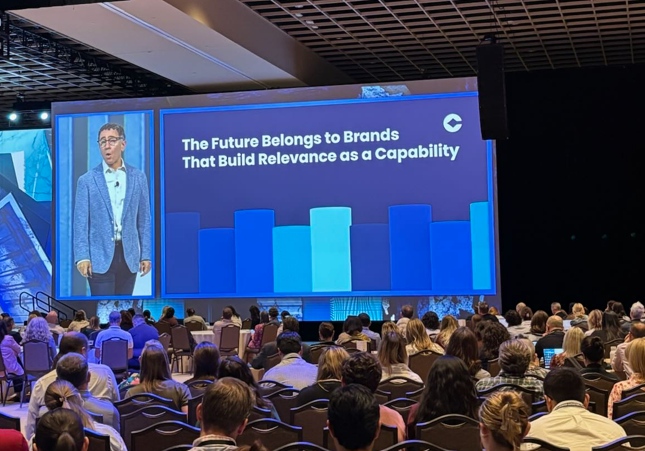
I spent the last few weeks pounding conference-hall pavement from Las Vegas to Nashville to New York to Orlando, and my step count broke records. My stops included Groceryshop, Shoptalk Fall, Advertising Week and ANA Masters of Marketing.
The topics ranged from AI shopping agents to direct mail to GLP-1 drugs, but every stage kept returning to one idea. Marketers have more channels, platforms and AI tools than ever, and the results depend on whether the target audience underneath them is accurate, current and tied to real households.
Key takeaways
- AI became plumbing. Advertising Week shifted from what AI can do to the data and identity hygiene that power it.
- Agents are shopping now. Salesforce forecasts that AI agents will drive 20% of 2026 holiday ecommerce traffic, and Groceryshop speakers urged brands to become findable in AI recommendations.
- Proof beats reach. Advertisers want spend tied to outcomes and to the specific households reached, not impressions.
- No single channel wins. ANA speakers described a portfolio approach, with direct mail, CTV and digital each earning a place.
- Life moments drive demand. New movers, new households and shifting life stages came up across events as the moments when buying habits reset.
- Trust decides spend. Shoptalk’s throughline was that trust decides where shoppers spend, and that retailers must now serve both shoppers and the AI agents shopping for them.
The four events at a glance
| Event | Location | Core theme | What it means for audience data |
|---|---|---|---|
| ANA Masters of Marketing 2026 | Orlando, Oct. 20 to 23 | Catalyzing Growth: no one channel can do it all | Build the audience right once, then reach it in every channel |
| Advertising Week New York 2026 | New York, Oct. 5 to 8 | AI is only as good as the data feeding it | Give AI and agentic buying accurate, household-level inputs |
| Shoptalk Fall 2026 | Nashville, Sept. 29 to Oct. 1 | Trust decides where shoppers spend | Structure product and customer data for people and for AI agents |
| Groceryshop 2026 | Las Vegas, Sept. 22 to 24 | Four decisions defining grocery for 2027 | Know which shoppers are changing, by value, health and AI use |
Trend 1: AI is only as good as the data feeding it
The most repeated lesson across all four events was that AI performance is a data quality problem.
At Advertising Week, the conversation moved from what AI can do to the trusted data, identity hygiene and context that let it make useful decisions. One theme was that the industry is very good at generating data, but connecting it in a way that improves decisions is much harder, and that better data, not more data, is what fixes it.
Groceryshop put numbers behind the gap. Incisiv found that only 7% of enterprises have scaled AI across the business, and research cited on stage showed that only 16.5% of retailers and CPGs can quantify ROI from AI. About 40% of CPGs and 29% of retailers still lack agentic governance frameworks. BCG’s Sebastian Bak estimated that 70% of AI success comes down to change management, not the model.
ANA speakers described the same foundation in plain terms: data quality is unglamorous, and it determines whether AI and omnichannel investments pay off. Their six fundamentals apply directly to any team building a target audience or a predictive model:
- Assess what you have.
- Integrate your data and deduplicate it.
- Standardize it.
- Enrich it.
- Set clear data policies.
- Monitor rigorously.
Why this matters for predictive modeling: a predictive model can only learn from the customer records it is given. If those records are duplicated, outdated or missing key attributes, the model scales the errors, which is why starting from deduplicated, enriched, household-level data is a sensible first step before modeling begins.
I’ve been at all four events, and one question came up again and again. Marketers weren’t asking me which AI tool to buy. They wanted to know whether they could trust the audience data behind it, and whether it was current enough to act on.
Trend 2: Agentic commerce makes audience accuracy more important
AI shopping agents moved from prediction to planning at Shoptalk Fall and Groceryshop.
Salesforce forecasts that agents will account for 20% of ecommerce traffic during the 2026 holiday season, and 74% of shoppers now say they trust AI recommendations.
Euromonitor reported that AI referrals have grown 376% since January 2025, though they are still only 2% to 3% of monthly visits, and VaynerX put agentic commerce at under 1% of transactions.
Influence is arriving before volume.
Groceryshop showed why brands cannot wait. Kantar found that 60% of consumers use AI for shopping at least sometimes. AI queries often return a consideration set of only three to five products, and Accenture found that 56% of loyal shoppers would switch brands if their AI agent recommended a better option.
Early assistants are producing results: DoorDash reported that Ask DoorDash baskets are 50% bigger than non-AI orders, and Albert Heijn’s AI assistant users spend 56% more than non-users.
Advertising Week added the media side. FreeWheel reported that agentic buying is moving into operational reality, with NBCUniversal, Carat, FreeWheel and Newton announcing an agentic buying solution for Upfront inventory. When software makes the buying decisions, the audience definition it receives carries more weight than ever. Inaccurate audiences scale inaccurate decisions.
What to do about it
- Treat product data and customer data as shelf space: structured, current and machine-readable.
- Give agentic and AI-driven buying tools verified, household-level audience inputs rather than broad, stale segments.
- Keep people in the loop. Shoptalk speakers noted that shoppers still check AI answers against friends, Reddit threads and human recommendations.
I saw the same gap across all four events: everyone has an AI plan, but far fewer people could tell me how accurate the audiences are that feed it.
Trend 3: No single channel does it all, and every channel must prove its outcomes
Attention is the scarce resource
ANA Masters of Marketing framed the challenge as a portfolio problem: channels, platforms and data now grow faster than marketers can keep up, so each channel has to earn its place by doing something the others cannot. Attention is the scarce resource. TVision’s 2026 State of Streaming report found that people watch more than four hours of video a day but pay attention to ads for only about nine minutes of it. Ad attention ranged from 77% on one CTV app to 25% on another, and individual programs ranged from 41% to 70%.
Direct mail earns its place
Direct mail was a surprise standout. Lob’s 2026 State of Direct Mail report found that 91% of direct mail users expect to maintain or grow spending, 79% of surveyed marketing executives rank it as their best-performing channel, and 94% say it improves engagement and conversions in digital channels. On the consumer side, 82% collect their mail daily or nearly daily, 87% read it the same day, and 79% have taken a digital action after receiving it.
Buyers want proof
Advertising Week said the era of scale without proof is over. For CTV in particular, buyers want to know what audiences did, how channels contributed and whether spend produced incremental value.
Quality also beat cheap reach: FreeWheel cited research showing up to 14X higher brand recall for top placements compared to bottom ones, and 54% of advertisers say they would pay a 20% higher CPM for professionally produced content.
Groceryshop reinforced the point in retail media, where only 31% of network leaders are confident their revenue is incremental and only 22% of brands are confident they can measure ROI.
| Challenge raised | Source | What audience data has to deliver |
|---|---|---|
| Attention varies threefold by environment | ANA, TVision | Reach the right people, not just the most impressions |
| Direct mail lifts digital conversions | ANA, Lob | One audience, planned across mail, CTV and digital |
| Vanity metrics are out | Advertising Week | Measurement tied to households reached and real-world outcomes |
| Retail media incrementality is unproven | Groceryshop, EMARKETER, Kantar | Match-back to actual customers and new-to-brand households |
Trend 4: Life events and life stages are where buying habits reset
Across events, the best examples of marketing were tied to a moment in a person’s life. At Advertising Week, brands such as Smirnoff, Hinge and Free People partnered with creators and artists instead of pushing top-down messaging.
The takeaway for data-driven marketers was that culture moves fast, and so do the life stages of younger consumers as they form new households, move and set new buying habits. As discovery and purchase collapse into the same moment, timing matters more.
Shoptalk Fall showed how early those habits form. NielsenIQ found that 29.1 million US households include a Gen Alpha child, each spending more than $3,000 a year above the average household and making 33 extra shopping trips a year. Gen Z and Gen Alpha make brand decisions almost instantly and rarely revisit them, so being present at the right moment decides the outcome. Teens on the Shoptalk panel said they trust creators who admit flaws and reject AI-made ads.
ANA speakers connected the dots for audience planning: data on life events, such as a recent move, a marriage or a new baby, shows marketers who to reach and when. That holds true whether the message lands in the mailbox, on CTV or across digital.
The same pattern showed up in my own conversations. The ones that went furthest started with a moment, like a move or a new baby, not with a channel.
Moments worth building audiences around
- New movers, who are setting up a new household and new routines
- Newly married households
- New parents
- Households shifting toward health or value, a major Groceryshop theme (see Trend 5)
Trend 5: Stores, value and health are reshaping who your customer is
Shoptalk and Groceryshop both argued that the customer is changing faster than most segmentation models.
On the store side, Ulta Beauty runs 80% of its sales through stores, which also fulfill more than half of its ecommerce. Best Buy’s new Bozeman store lifted ship-to-home sales more than 20 times in a year, and at Kohl’s more than 25% of customers picking up digital orders buy something else while there. Stores influence digital demand, so measuring them on store sales alone undercounts their value.
Loyalty is also being redefined. Shoptalk presenters cited research that about half of loyalty points go unredeemed and annual member churn runs 13% to 23%.
Memberships that deliver everyday value, such as Walmart+, where members shop three times as often as non-members, are winning.
At Groceryshop, NielsenIQ reported that consumers who identify as financially struggling now make up a third of the US population, and described shoppers as no longer hunting for a deal but assembling one.
GLP-1 adoption was the sleeper topic. PwC data presented at Groceryshop showed that 21% of US households now have a GLP-1 user, up from 9% in 2025, and Walmart Connect research showed a 52% drop in brand loyalty at a health-shift moment. Yet only 17% of grocery executives expect a 5% to 10% hit to top-line sales over five years, and just 2% expect more. Those households are changing what they buy now, which makes current household-level data valuable for spotting them.
The audience data implication
Value-seeking, health-shifting and newly mobile households do not look like last year’s loyal customers. Brands need current consumer data to spot these shifts, and to decide whether a household deserves an offer, a reminder or a first introduction.
Predictive modeling and target audiences: build them from better data
Predictive modeling scores people or households by how likely they are to buy, respond or switch.
Marketers use those scores for audience segmentation, to decide who gets mail, who sees CTV and digital ads, and who is left out of a campaign to protect budget.
The model is only as good as the data it learns from. Four themes from the events point the way: clean first-party data, real households, current life-event signals and proof of results.
A practical playbook: build smarter target audiences and predictive models
Putting the four events together, here is a sequence marketers can apply to customer and prospect data in the next 90 days.
- Audit your customer file. Assess, deduplicate and standardize records so every household is counted once.
- Enrich with current consumer data. Add household-level attributes and life-event signals so models start from an accurate picture.
- Build a clean seed audience. Use your best customers as the seed for predictive modeling and lookalike audiences, so prospect targeting reflects who actually buys.
- Layer moment-based triggers. Add new mover, newly married and new parent signals to reach people when buying habits reset.
- Activate across the portfolio. Plan direct mail, CTV and digital from the same audience so each channel reinforces the others.
- Measure against real-world outcomes. Match results back to the households you reached, and track new-to-brand customers and incremental lift rather than impressions.
- Govern and monitor. Set data policies and review audience quality on a schedule, especially before feeding audiences to AI or agentic buying tools.
| Trend | Where it surfaced | What it demands from audience data |
|---|---|---|
| AI as plumbing | Advertising Week, Groceryshop | Clean, deduplicated, enriched inputs |
| Agentic buying and shopping | Advertising Week, Shoptalk, Groceryshop | Accurate household-level audiences and structured data |
| Proof over reach | Advertising Week, ANA, Groceryshop | Outcome measurement tied to households |
| Omnichannel portfolio | ANA | One audience activated in mail, CTV and digital |
| Life moments | Advertising Week, ANA, Shoptalk | Event and trigger data that stays current |
| Changing loyalty, value and health | Shoptalk, Groceryshop | Fresh signals on who is shifting |
Key statistics from the four events
These figures explain why audience accuracy and measurement came up at every event. The last column shows what each one signals for marketers.
| Statistic | Figure | Source | Event | Why it matters |
|---|---|---|---|---|
| AI agents’ share of 2026 holiday ecommerce traffic (forecast) | 20% | Salesforce | Shoptalk Fall | Agents are already part of holiday traffic planning |
| Shoppers who trust AI recommendations | 74% | Salesforce | Shoptalk Fall | Trust in AI advice is already high |
| Growth in AI referrals since January 2025 | 376% | Euromonitor | Shoptalk Fall | Fast growth, though still a small share of visits |
| Consumers who use AI for shopping at least sometimes | 60% | Kantar | Groceryshop | AI is a mainstream starting point for shopping |
| Loyal shoppers who would switch if their AI agent recommended a better option | 56% | Accenture | Groceryshop | Brand loyalty offers limited protection |
| Enterprises that have scaled AI enterprise-wide | 7% | Incisiv | Groceryshop | Most AI projects have not scaled yet |
| Retail media network leaders confident their revenue is incremental | 31% | EMARKETER and Bain | Groceryshop | Incrementality is still unproven |
| US households with a GLP-1 user (up from 9% in 2025) | 21% | PwC | Groceryshop | Baskets are changing faster than many forecasts |
| Marketing executives who rank direct mail as their best-performing channel | 79% | Lob, 2026 State of Direct Mail | ANA Masters of Marketing | Direct mail earns a place in the channel mix |
| Daily video time versus time attending to ads | 4+ hours versus about 9 minutes | TVision, 2026 State of Streaming | ANA Masters of Marketing | Attention, not reach, is the scarce resource |
| Brand recall for top versus bottom placements | Up to 14X higher | Research cited by FreeWheel | Advertising Week | Placement quality changes outcomes |
Key definitions
Predictive modeling: Predictive modeling uses statistical techniques and a seed set of known customer data to estimate which people or households are most likely to take an action, such as making a purchase, so marketers can prioritize them.
Target audience: A target audience is the group of consumers or households a campaign is built to reach, defined by attributes such as demographics, behaviors, location and life events.
First-party data: First-party data is information a company collects directly from its own customers and prospects, such as purchases, sign-ups and loyalty activity. It is the most common seed for predictive models and lookalike audiences.
New mover data: New mover data identifies households that have recently changed addresses. Moving is a life event when households set up new routines and buying habits.
Agentic commerce: Agentic commerce is shopping and buying carried out by AI agents acting on behalf of a consumer or a marketer, from product discovery through checkout.
Where Speedeon fits
Speedeon builds audiences that reflect how real people live and change: new movers (updated daily), newly married households, new parents and shifting life stages. Marketers use these household-level audiences to give AI and agentic platforms accurate inputs, activate across direct mail, CTV and digital, and measure performance against real-world outcomes instead of impressions.
That positioning lines up with what the four events asked for. Clean, current data is the foundation for AI. Accurate household audiences keep agentic buying from scaling bad decisions. Moment-based data tells marketers when to reach someone, and outcome measurement answers the demand for proof.
The industry has the tools. The advantage now belongs to marketers who feed them the right audiences.
About Speedeon: Speedeon is a marketing data and audience solutions company. It builds household-level audiences, including new movers, newly married households and new parents, and helps marketers activate them across direct mail, CTV and digital and measure results against real-world outcomes.
Frequently asked questions
What were the biggest marketing takeaways from Advertising Week New York 2026?
Advertising Week New York 2026 shifted from AI hype to the data and identity hygiene underneath it. Marketers also saw agentic buying begin to scale, demanded proof over vanity metrics, favored quality placements over cheap reach, and watched content, commerce and CTV converge.
What did Shoptalk Fall 2026 say about AI shopping agents?
Shoptalk Fall 2026, held Sept. 29 to Oct. 1 in Nashville, reported that Salesforce forecasts AI agents will drive 20% of 2026 holiday ecommerce traffic, while VaynerX put agentic commerce at under 1% of transactions. Speakers advised retailers to structure product data so agents can read it and to keep a human option available.
Why does audience data matter for agentic commerce and agentic buying?
Agentic buying tools make decisions from the audience and product data they are given. If the audience is inaccurate, the agent repeats and scales that inaccuracy, so accurate, current, household-level data is a prerequisite.
How does predictive modeling improve target audiences?
Predictive modeling uses a seed audience, typically a brand’s best customers, to find other households with similar characteristics and a higher likelihood to buy. The cleaner and more current the seed data, the more accurate the resulting target audience.
Is direct mail still effective in 2026?
Lob’s 2026 State of Direct Mail report, presented at ANA Masters of Marketing 2026, found that 79% of surveyed marketing executives rank direct mail as their best-performing channel and 94% say it improves engagement and conversions in digital channels.
What are new mover audiences and why do they matter?
New mover audiences are households that have just moved to a new address. After a move, people pick new stores, services and brands, which makes it one of the best times for a brand to introduce itself.
What did Groceryshop 2026 say about GLP-1 drugs and grocery?
At Groceryshop 2026 in Las Vegas (Sept. 22 to 24), PwC data showed that 21% of US households have a GLP-1 user, up from 9% in 2025, and Walmart Connect research showed a 52% drop in brand loyalty at a health-shift moment. Grocery spending falls sharply in these households, so retailers and brands should plan for a larger impact than many forecast.
What is agentic commerce?
Agentic commerce is when AI agents find, compare and buy products for a shopper or a brand, handling the whole journey from search to checkout. At the 2026 events, speakers reported that it already influences purchases even though it is still a small share of transactions.
What is first-party data and why does it matter for predictive modeling?
First-party data is the customer information a brand gathers itself, through purchases, loyalty programs and its own channels. Predictive models are usually built from it, so the quality of that data limits how accurate the final audiences can be.
Sources and event notes
- ANA Masters of Marketing 2026, Orlando: conference recap, including TVision’s 2026 State of Streaming report and Lob’s 2026 State of Direct Mail report.
- Advertising Week New York 2026: conference recap, including FreeWheel research and announcements.
- Shoptalk Fall 2026: Unpacked report, Nashville, Sept. 29 to Oct. 1, 2026 (fall.shoptalk.com).
- Groceryshop 2026: Unpacked report, Mandalay Bay, Las Vegas, Sept. 22 to 24, 2026 (groceryshop.com).
- Third-party statistics are attributed to the organizations named by each event’s speakers and reports (Salesforce, Euromonitor, Kantar, Accenture, NielsenIQ, PwC, Walmart Connect, Incisiv, BCG and others).
