

That overlap, the household move and the school year reset, is one of the most underused targeting opportunities in retail marketing. Here’s what the data says about who these movers are, why they spend differently, and which Speedeon audience segments help you reach them.
Why Moving and Back-to-School Create a Compounding Spending Moment
A household move is already one of the biggest consumer spending triggers that exists. New movers shop for furniture, set up new utilities, switch insurance, and explore every local business near their new address. Speedeon’s broader new mover research shows this decision-making window is concentrated: most of that activity happens in the first 30 to 60 days after a move.
Now overlay the start of a school year on top of that. A family that moved in June or July isn’t just unpacking boxes. They’re also enrolling kids at a new school, meeting new teachers, and lining up after-school activities while tracking down whatever didn’t survive the move, often on a compressed timeline with none of the built-in loyalty a household ten years into the same house would already have.
That’s the compounding effect. Two high-intent moments, stacked on top of each other, in the same six-to-eight-week window.
How Many of These Households Actually Exist?
This isn’t a theoretical audience. Speedeon’s digital taxonomy includes segments built specifically at this intersection, and the scale is real. Here’s what the data shows:
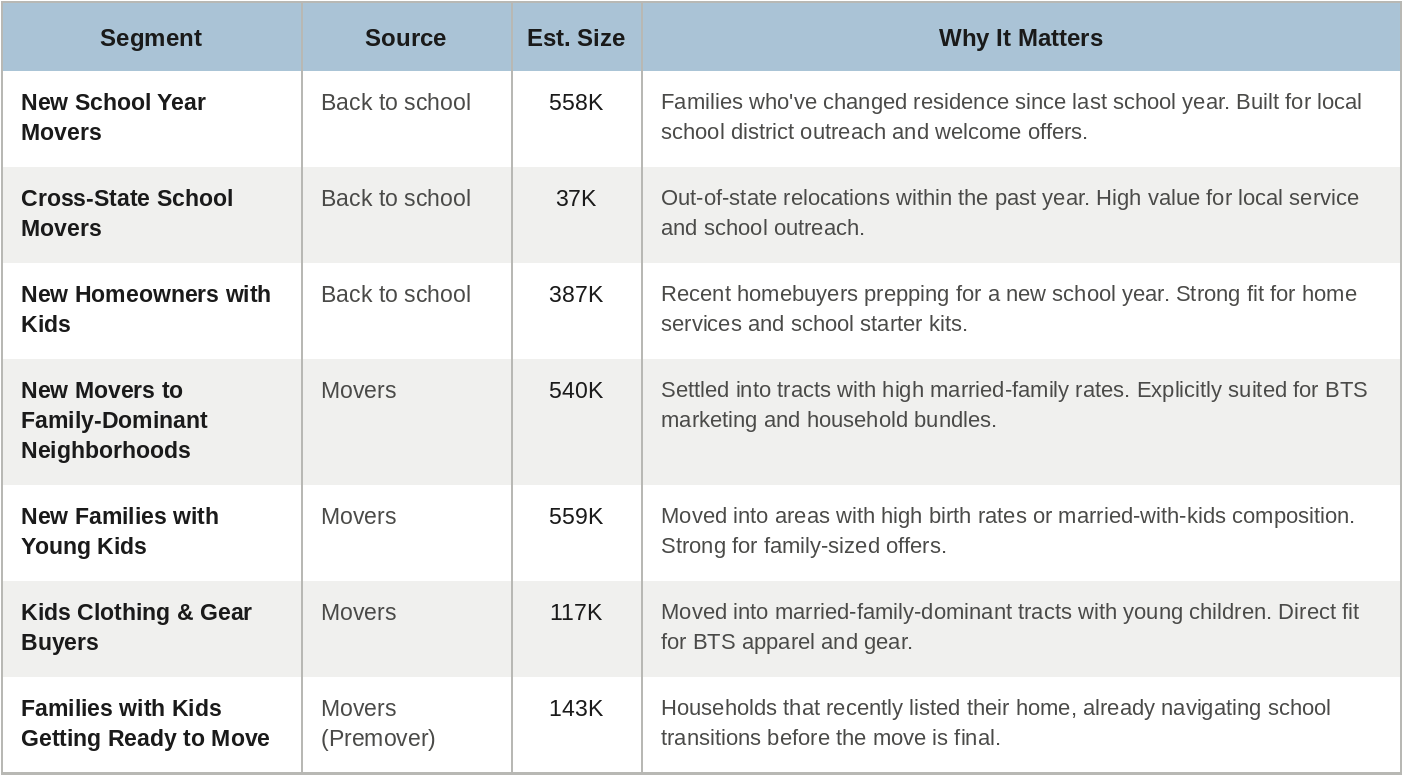
All segment data sourced from the Speedeon Digital Taxonomy, updated January 2026. Sizes are national estimates. Underlying Movers data refreshes daily, with buyers able to select the update cadence (often weekly) that fits their campaign; Back to School segments refresh every 6–8 weeks.
What Makes the Moving Family Different From the Typical BTS Shopper?
A family that’s lived in the same home for years already knows where they’re buying backpacks. A mover doesn’t. They haven’t picked a default grocery store, a go-to pharmacy, or a preferred local retailer yet. That’s an opening: the brand that reaches them first has a real shot at becoming the default for years, not just for one shopping season.
This is also a household actively spending across more categories than a typical BTS shopper. They’re not just buying school supplies. Many are still furnishing rooms, setting up internet and streaming services, and exploring nearby restaurants and services, all while making first-time decisions about schools, sports leagues, and pediatricians.
Three sub-groups worth targeting differently
- Cross-state movers: Out-of-state families have the least local brand familiarity of any BTS audience. They need orientation as much as they need products, think “welcome to the area” messaging alongside the product pitch.
- New homeowners with kids: This group is balancing a mortgage and a move with school costs. Home-plus-school bundles, like home services paired with school starter kits, land better than a straight product pitch.
- Premover families with kids: Reaching a family before they’ve even moved, while they’re still researching schools and neighborhoods, is one of the earliest entry points available. These households are listed and actively planning, which makes them reachable weeks before the standard BTS push even begins.
How to Activate This Audience
These segments aren’t locked into one channel. Speedeon audiences activate through partners like LiveRamp, Growth Channel, and Cadent for programmatic, CTV, and OTT buys, or upload as people-based records into data warehouses and clean rooms like Snowflake for fully custom setups.
Direct mail also remains one of the strongest channels for this audience specifically. New movers are getting mail at a brand-new address for the first time. There’s no inbox fatigue built up yet, no ad blocker trained on their habits, just an open mailbox nobody’s claimed. Pairing direct mail with the same audience selects used for CTV and digital keeps messaging consistent across every touchpoint.
Frequently Asked Questions
Are families who moved recently actually a bigger back-to-school opportunity than typical BTS shoppers?
Per household, often yes. Movers are simultaneously making decisions across more categories (home, school, local services) than an established household, and they haven’t yet formed brand loyalty in their new area. That combination tends to produce a higher response rate to first-touch offers compared to BTS campaigns aimed at families with years of established shopping habits.
How fresh is mover and back-to-school data?
Speedeon’s underlying Mover Data updates daily. Buyers can choose the refresh cadence that fits their campaign, weekly is common, though other cadences are available depending on need. That flexibility matters for this audience specifically, since the window between a move and the start of the school year is short, and stale data means missing the moment entirely. Reach out to the Speedeon Audience Desk to set the update frequency that works best for your campaign.
Can I combine mover and back-to-school targeting with other life events?
Yes. Because Speedeon’s segments are built on the same underlying data, mover and BTS audiences can be layered with other life-event and demographic data, like new homeowner status, household income tier, or family composition, to build a more precise custom audience through the Speedeon Audience Desk.
What’s the best time to start targeting back-to-school movers?
Earlier than most brands assume. Premover segments like Families with Kids Getting Ready to Move are reachable while a home is still listed, often weeks before the family has physically relocated. Starting outreach at the premover stage, rather than waiting until after the move is complete, captures this audience before competitors do.
Reach Back-to-School Movers Before Your Competitors Do
The families overlapping a move and a new school year are a small slice of the total back-to-school market, but they’re disproportionately valuable: more categories in play, less existing brand loyalty, and a real opportunity to become their default before anyone else does.
Speedeon’s Audience Desk can help you build a custom segment combining mover and back-to-school data, sized and activated across the channels you’re already using.