

It makes sense to think that direct mail is a thing of the past. Nowadays, people’s lifestyles are often defined by electronic devices. Digital communication like email, text, and social media are considered more efficient ways to connect with customers as they are almost always online. Ironically, that’s precisely what makes marketing with direct mail stand out from its digital counterparts.
Direct mail lead generation can be more effective in cutting through the noise and putting your brand under the spotlight, compared to an email drowning in an already overwhelmed inbox.
Would you prefer your message to be in an inbox filled with countless other promotional materials that customers don’t even bother to open or have it delivered to their hands?
The key point is simple. Direct mail isn’t just about boosting brand awareness. It is a highly lucrative channel for lead generation. It can bring qualified, high-value prospects to your business.
Speedeon is a consumer data provider that helps marketers identify high-intent audiences and power direct mail lead generation campaigns through accurate targeting and audience insights.
At Speedeon, we help our clients identify and execute the best lead generation strategy for them – be it fully online, offline, or a combination of both.
In this guide, we explore everything you need to know about using direct mail for lead generation – the core elements and strategies, audience targeting, and optimizing your campaigns across both B2B and direct-to-consumer (DTC) marketing programs.
>> Not sure where to get started? Book a Direct Mail Strategy Call here! >>
What Is Direct Mail Marketing?
Marketing with direct mail means sending out advertisements or promotional messages through the postal system, directly to the customer’s doorstep, as part of direct mail marketing campaigns. It can be postcards, letters, brochures, samples, catalogs…take your pick! These tactics have been around for ages.
Direct mail is a lucrative marketing strategy for both B2B and B2C brands looking for a highly targeted channel to connect with their clients. Thanks to its versatility, sectors such as retail, insurance, finance, and home services use it as an integral part of their marketing strategies. If you implement accurate, up-to-date life event data to nurture your audience at the right stage of the buying cycle, you can maximize its benefits.
Why Is Direct Mail Still Relevant?
Direct mail is tangible – a stark contrast with the digital world. When there’s an excess of digital noise, email marketing and online ads, consumers experience digital fatigue and may find it difficult to keep track of the promotions they get. But, when you physically deliver a well-designed piece of creativity, it can create a lasting impression.
Moreover, the increase in consumer data over the years has allowed businesses to perfect their direct mail targeting efforts and execute successful direct marketing campaigns with higher ROIs.
But, it doesn’t mean you forgo marketing with digital channels. In contrast, cross-channel activation that uses both online and offline channels can yield better results. It can help you reach a wider audience, establish a strong presence in the market, and accelerate lead generation. It also contributes to delivering a seamless customer experience, improving retention and loyalty.
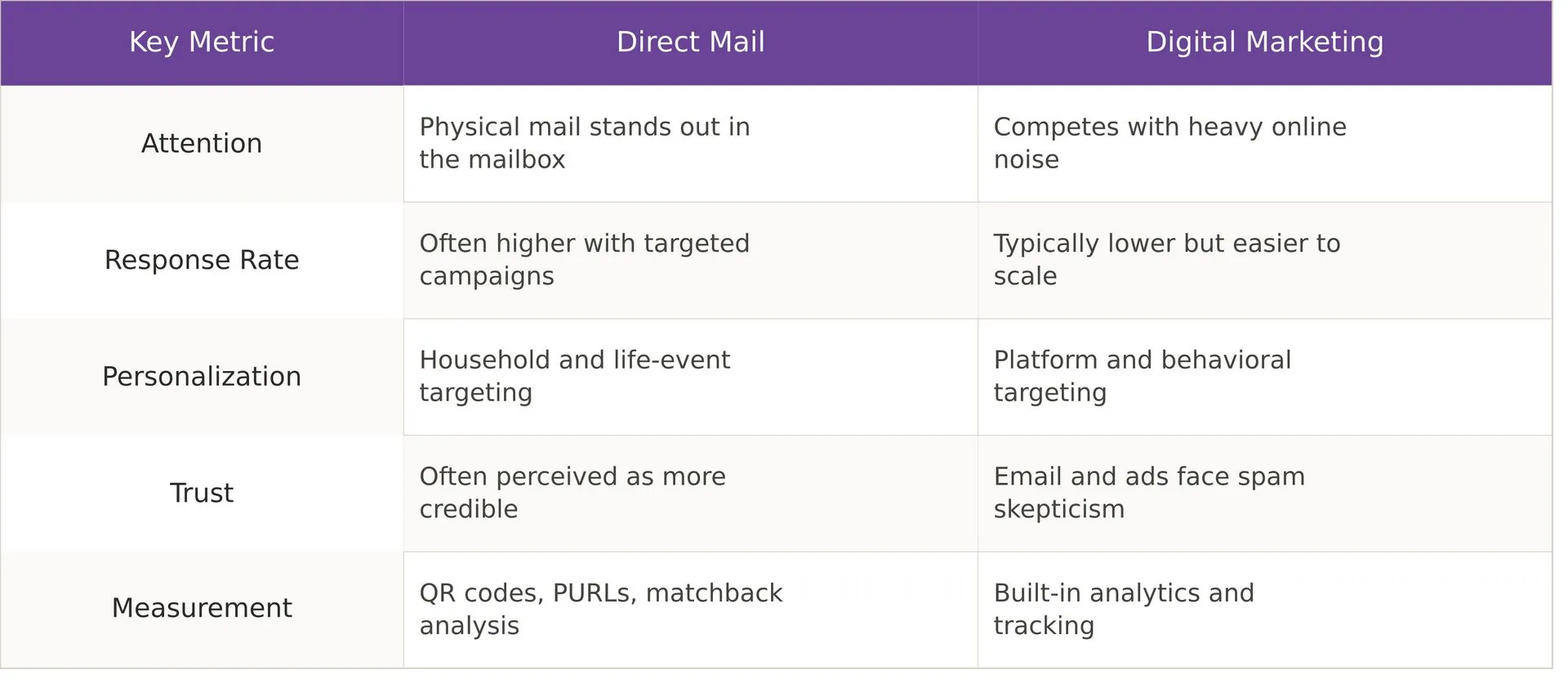
Here’s a quick comparison of direct mail and digital marketing across a few key campaign metrics.
Direct Mail Lead Generation: How It’s Different from Direct Mail Marketing
Direct mail marketing and direct mail lead generation are often used interchangeably, but they are not the same thing. While direct marketing is a broad strategy that focuses on promotion, awareness, and brand loyalty, direct mail lead generation is specific. It focuses on identifying and capturing prospects with high-intent offers to generate sales.
Direct mail lead generation combines physical mail with digital touchpoints to encourage prospects to respond. Its effectiveness follows the 40/40/20 rule: 40% audience targeting (data quality), 40% the offer itself, and 20% creative execution and timing. Core tactics include personalized messaging, QR codes that connect recipients to online experiences, and a compelling lead magnet to encourage engagement.
Success of direct mail lead generation is not how many people receive a mail piece or even how many respond. It is about how many qualified prospects are created, how those prospects progress through the funnel, and how many convert into customers in the end.
This distinction between direct mail marketing and lead generation matters because it changes how campaigns are planned, measured, and optimized. A branding mailer might aim for reach and recognition. A lead generation mailer must be engineered around:
- Clear conversion actions (form submissions, calls, QR scans)
- Traceable attribution paths
- Audience signals that indicate intent or readiness to engage
- Downstream lead quality and revenue impact
If your business is running performance marketing campaigns, direct mail combined with the right data can become a high-signal acquisition tool rather than a general promotional medium.
Direct Mail Lead Generation Strategies
Direct mail campaigns perform best when they focus on clear acquisition goals instead of broad promotion. Instead of sending broad marketing messages, successful programs focus on reaching the right audience, presenting a compelling offer, and providing a clear path for prospects to respond.
Most effective direct mail lead generation programs follow three strategic approaches.
Awareness-Led Campaigns
Awareness-led campaigns introduce your brand or service to new audiences while encouraging measurable engagement. Rather than focusing solely on visibility, these campaigns include a clear next step such as visiting a landing page, scanning a QR code, or requesting more information.
This approach is often used when entering new markets, launching new services, or expanding into new audience segments.
Offer-Led Campaigns
Offer-led campaigns aim to drive immediate engagement through a clear value exchange. Prospects are encouraged to respond by redeeming an incentive or accessing useful content.
Examples include free consultations, educational reports, event invitations, or promotional discounts. When paired with trackable response paths such as personalized URLs or QR codes, these campaigns can generate a consistent flow of direct marketing leads.
Trigger-Based Campaigns
Trigger-based campaigns focus on timing outreach around moments of heightened purchase intent. Life events, behavioral signals, or business milestones can indicate when a prospect may be actively evaluating solutions.
By aligning outreach with these signals, businesses can reach prospects when they are more likely to respond and convert.
Together, these strategies provide a framework for designing direct mail campaigns that consistently generate qualified leads.
A Simple Direct Mail Lead Generation Framework
Step 1: Define the acquisition goal
Start by identifying what the campaign should achieve. This could be generating consultation requests, capturing qualified leads, or driving prospects to a landing page.
Step 2: Build the target audience
Use demographic, behavioral, and intent data to identify prospects most likely to respond. High-quality data is critical to ensure mail reaches the right households or decision-makers.
Step 3: Develop the offer
A direct mail campaign performs best when it includes a clear value exchange. Examples include consultations, reports, discounts, or event invitations.
Step 4: Design the mail piece
The design should be simple, visually clear, and built around a single call to action. Including QR codes or personalized URLs makes it easy for recipients to respond.
Step 5: Connect to digital channels
Direct mail campaigns are most effective when integrated with digital touchpoints such as landing pages, email follow-ups, and CRM tracking.
Step 6: Track responses and optimize
Measure results using metrics such as cost per lead, lead quality, and conversion rate. Campaign insights should be used to refine targeting, messaging, and offers over time.
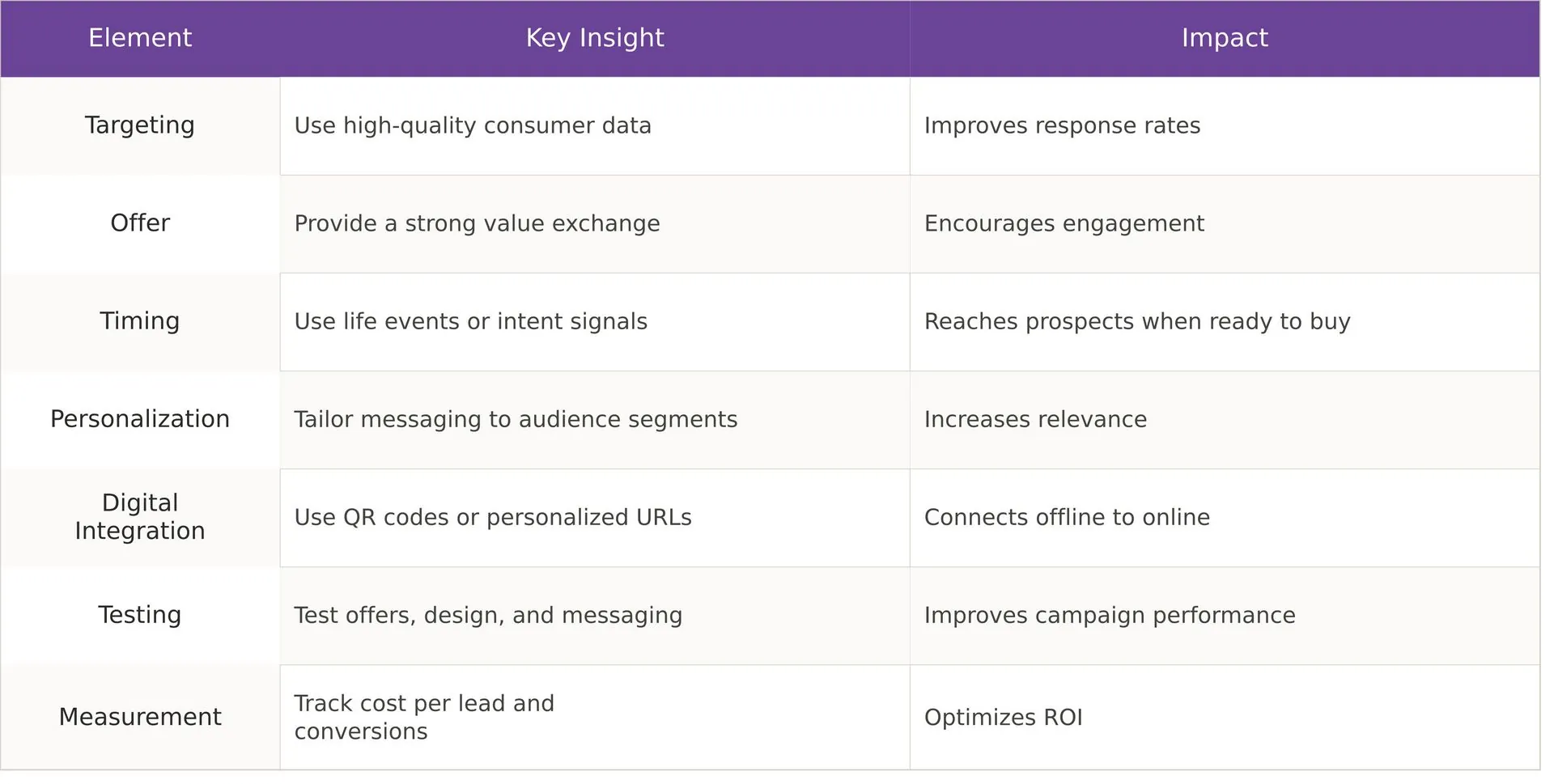
Key Elements of Successful Direct Mail Lead Generation
Benefits of Direct Mail Lead Generation
Personalized direct mail
With direct mail, you don’t have to go with a vanilla ‘one-size-fits-all’ message’ and hope it appeals to your target audience. It is possible to create highly personalized content using segmentation and predictive analytics, enhancing direct mail personalization. The target audience’s demographics, interests, and purchasing behaviors can help in curating custom messages. It can boost your lead gen’s ROI and improve loyalty because customers know that the brand is well aware of their needs.
More precision
Many leading and high-end brands go for direct mail lead generation because it offers a greater degree of precision when it comes to targeting. If you have the right data in your hands, you will know the exact customers in the market seeking your products. Best of all, with data monitoring, you will also know when to target and win their attention. Here’s how Speedeon helped a leading furniture retailer re-strategize and sharpen their direct mail campaign using mover data.
Higher response rates
When executed right, direct mail campaigns deliver greater visibility and higher response rates, generating valuable direct mail leads for your business. Customers are more likely to respond to your offer if it’s customized and appeals to their requirements and preferences.
Legitimacy
There’s been an increase in scams and phishing activities lately and for this reason, customers can be hesitant to open emails with promotional content, especially from a brand they don’t know. So, direct mail can be a great way to overcome the issue of credibility.
Reach new segments
Another benefit of direct mail is that it allows you to connect with customer segments that are hard to reach through digital modes of communication. It is especially true if the product or service caters to segments like senior citizens.
What are the Drawbacks of Direct Mail?
Higher Setup Cost
One of the barriers preventing brands from marketing with direct mail is the cost. A significant budget should be allocated for designing the mail piece, printing, postage, and other service fees involved in the process. However, the increase in response and conversion rates make up for higher costs on the front end, as long as the ads are well targeted.
Inaccuracies in the mailing lists
If your mailing list contains outdated information, such as old home addresses, your message won’t reach your audience. It’s essential to implement data hygiene and enrichment practices to remove irrelevant, outdated, or duplicated data – and validate existing information. Reliable third-party data will help fill in the gaps in your existing mailing list and even expand it.
>> Not sure where to get started? Book a Direct Mail Strategy Call here! >>

Direct Mail Marketing Strategies that Convert
Direct marketing lead generation does require significant investment, compared to digital modes of marketing, and therefore it’s important to do it right. Here are key direct mail marketing strategies that can help your campaign stand out!
Being SMART with your goal
Simply kicking off a generic campaign will not yield results if you don’t have clear objectives outlined. A set of intended outcomes makes the campaign more focused and more effective. Make sure your goal is Specific, Measurable, Achievable, Relevant, and Time-bound.
Having a specific target audience
Effective targeting ensures your message reaches the right audience at the right time. The greater the understanding of your customers and their next move, the greater the potential for influencing their purchasing decisions. Understand your customers’ demographics, purchasing behavior, interests, and motivations and segment for a high level of personalization.
Strong theme and design
Design is critical to the success of your direct mail lead generation campaign. Your mailer should be visually appealing, easy to read, and easy to understand. It should also be designed to be attention grabbing and encourage readers to take action.
Consider the following tips:
- Use a clear and concise layout that’s easy to follow.
- Use high-quality images that are relevant to your message.
- Use a clear and easy-to-read font that’s consistent throughout the piece.
- Use a compelling headline that grabs the reader’s attention.
- Use a sense of color and texture to make the piece visually appealing.
Including an irresistible offer and help remove objections
Your marketing message should include a compelling, personalized direct mail offer, aligning with your audience’s buying behavior and expectations. It should persuade the customer to engage with the mail piece. Well-thought-out copywriting will be your ally here. Make sure you include a value-driven offer that will help clear out objections-for example, a guarantee.
When crafting your message, consider the following:
- Use a clear and concise headline that grabs the reader’s attention.
- Use a personalized greeting that addresses the reader by name.
- Use a compelling offer that resonates with the reader’s interests and needs.
- Use a clear and direct call-to-action that tells the reader what to do next.
- Use a sense of urgency to encourage the reader to take action.
It’s key here to work to remove the “risk” from the purchase. Of course, you see this all the time online. The key difference here may be how your guarantee is visually displayed in your mailer.
A Compelling CTA
Implement a compelling call to action (CTA) that gets the customers to move on to the next step of the buying journey. Think about how you can get them to consider your product or purchase by differentiating your brand from your competitors. A good CTA will get things going!
Establishing the brand’s digital presence
Relying on direct mail doesn’t mean you let go of your digital marketing efforts. This helps prospects transition seamlessly from offline to online interactions.
Backing your campaign with data
One of the key direct mail marketing strategies is to back your campaign strategy with data every step of the way. Even if you are an upcoming brand with limited first-party data, augmenting it with reliable third-party consumer data can get you ahead of the game. Access to high-quality consumer data can shape, refine, and transform your campaigns.
Overall, effective direct mail marketing strategies combine targeted, personalized physical mail – such as postcards, letters, or brochures – with digital integration, clear calls to action (CTAs), and coordinated multi-wave campaigns. Common approaches include, tailoring content to specific audience segments, and incorporating QR codes or personalized URLs (PURLs) to help track responses and measure ROI.
Why Is High Quality, Fresh Data a Non-Negotiable Requisite When Marketing with Direct Mail?
Identify high-value clients
One of the major benefits of using data for your direct mail campaigns is that it helps you narrow down your targeting to find the potential customers who are more likely to respond to your offers. It will reduce marketing spend, drive response rates up, and increase customer lifetime value. At Speedeon, we offer our clients over 1000 variables to help them segment their customers’ personal and behavioral data easily.
Build your ideal customer profile
Having a comprehensive understanding of your customers is vital for offering them personalized experiences.
Execute trigger marketing campaigns
Trigger marketing strategies, driven by your customer data, can take your direct mail campaign to a whole new level. By enriching your first-party data with third-party life event data, you can track when customers go through a major life event and send a tailored offer to their doorstep when they need it the most! As you are targeting people who are in the market and ready to buy, you should see a higher ROI.
Update your mailing list
The strength of your direct mail marketing strategies relies on the strength of your mailing list. You can create lookalike audiences by enriching your limited client data with outside data sources. This way, you can identify new prospects with similar traits to your best customers and target them in your direct mail lead generation campaigns.
How to Nail Direct Mail Targeting with Better Data
Targeting is the single most important factor in direct mail lead generation performance. Because direct mail has a higher cost per touch than most digital channels, sending mail to the wrong audience is not just inefficient – it is financially destructive.
In most successful campaigns, the backbone of a strong direct mail targeting strategy is high-quality data and best data hygiene practices. It helps you go beyond basic list purchasing or broad geographic targeting and identify high value direct mail leads. Strong targeting typically brings together multiple data sources and audience insights, including:
Demographic Signals
These include age, gender, presence of children, marital status, household income, location, and property ownership. While these variables alone are not sufficient for lead generation, they lay a strong foundation for understanding your prospects and segmenting audiences.
Behavioral and Intent Signals
Behavioral data introduces predictive power into targeting. Signals such as past purchase behavior, website activity, content engagement, or product usage can indicate real interest rather than theoretical fit. When applied to direct mail, these signals allow brands to focus outreach on audiences who are already in the market, looking to buy!
Life Event and Trigger Data
Life events often represent moments of heightened purchase intent. In B2C, these are often moving houses, getting a new job, having a child etc. In a B2B scenario, this could be, formation of the business, transitions in leadership, changes in financial circumstances. Trigger marketing leverages these moments to reach prospects when they are most likely to respond.
Household-Level vs. Individual-Level Targeting
Direct mail offers a unique advantage over many digital channels by enabling household-level targeting. This is particularly valuable in consumer markets where purchase decisions are often made collectively within the household rather than by a single individual. Or perhaps decisions are made by an individual, but not the one you imagine, allowing your mail piece to be easily routed to the right person (or pushed across the counter). Example: a spouse purchases items for use by the other spouse.
Suppression and Exclusion Strategies
Just as important as who you include is who you exclude. Suppression strategies remove existing customers, low-probability segments, or previously unresponsive audiences. This improves efficiency, reduces waste, and increases overall campaign ROI.
Essentially, targeted direct mail maximizes ROI by delivering personalized messaging to high-intent segments defined by demographic, geographic, and behavioral data, rather than relying on broad outreach. Customized mailing lists-filtered by factors such as income level, homeownership status, or purchase history-reduce waste and improve response rates. Tactics like Every Door Direct Mail (EDDM) for local reach can work well when paired with a targeting system to help select the right carrier routes. Retargeting mail for known website visitors can further strengthen targeting precision.
Using Predictive Modeling to Reach High Value Direct Mail Leads
Predictive modeling will soon be indispensable to direct mail lead generation, owing to its ability to power up highly targeted direct mail campaigns.
Predictive modeling refines direct mail targeting by identifying which prospects are most likely to respond before outreach begins. By analyzing consumer data, campaign performance, and life-event signals – and evaluating thousands of variables simultaneously – predictive models uncover patterns linked to buying intent, allowing marketers to focus on audiences with the highest likelihood of engagement rather than relying on broad lists.
For direct mail lead generation, where production and postage costs are significant, this level of intelligence is critical. Predictive modeling allows marketers to:
- Prioritize high-probability audiences
- Reduce wasted mail volume
- Improve response rates and cost per lead
- Scale campaigns while maintaining lead quality
Rather than increasing campaign size, predictive modeling increases precision.
Predictive insights can also support lookalike audience modeling, helping marketers expand campaigns by identifying new direct marketing leads who share similar characteristics with their highest-performing customers. This allows organizations to scale reach while maintaining lead quality. At Speedeon, predictive modeling combines extensive consumer data, advanced analytics, and campaign performance insights to identify audiences entering key decision-making moments, enabling more precise targeting, timing, and messaging.
As campaigns generate new response data, models continuously refine audience selection, turning direct mail into an adaptive, data-driven acquisition channel. Learn more in Speedeon’s guide to fast predictive modeling for direct marketing agencies.
Direct Mail for Direct-to-Consumer Lead Generation
Direct-to-consumer brands often rely heavily on digital channels for customer acquisition, but the market is too crowded and the rising ad costs have added to the burden. Going back to the good ol’ mail to approach your clients can be a complementary but a powerful way to capture high value direct mail leads.
Prospecting Campaigns
Prospecting mailers are often used to introduce a brand to new audiences. Sometimes the starting point is a small digital signal – a website visit, a form submission, or someone signing up for content but not taking the next step.
That’s where direct mail can come in. A targeted mail piece allows the brand to reconnect with that prospect in a different environment and keep the interaction moving. In many cases, a clear incentive, such as a discount code, free trial, or exclusive offer, encourages recipients to revisit the brand online.
Reactivation and Win-Back
More often than not, customers drift. Someone buys once, subscribes to an email list, then disappears. It happens. Direct mail can help pull those people back into the fold. Unlike emails that get buried under dozens of other promotions, a physical piece lands right in front of the recipient.
Lifecycle-Based Outreach
Direct mail can also play a role throughout the customer journey. Using customer data, brands can trigger mail at key moments-after a purchase, when a renewal is approaching, or when there’s an opportunity to introduce a complementary product. The trick is timing. When outreach matches what the customer might actually need at that moment, engagement tends to be much stronger.
B2B Direct Mail Lead Generation: Turning the Right Doors into Opportunities
What direct mail strategies suit B2B marketing is vastly different from that of consumer marketing. You’re not persuading someone to toss a product into their online cart at midnight because it looked nice on Instagram. No, here you’re dealing with organizations. Layers of people. Committees, budgets, cautious emails, the occasional painfully long meeting. Decisions move slower. Stakes? Much higher.
And because of that, outreach has to work differently.
B2B direct mail lead generation tends to revolve around a tighter circle of carefully chosen companies. The ones that actually matter, with both the need and the budget. Messaging then gets shaped around them, almost like writing a note specifically meant for that door.
Account Selection and Prioritization
Before anything gets printed or mailed, the real work starts with figuring out which companies are worth your time.
In B2B direct mail lead generation, not every organization is the right fit. Smart teams dig into firmographic data such as industry, company size, and location, then layer that with past deal data to see what kinds of accounts have converted before. Some companies even bring predictive models into the mix to spot prospects with the highest likelihood of converting. In short, it’s about focusing on the accounts that truly move the needle.
Multi-Stakeholder Engagement
In B2B campaigns, buying decisions rarely sit with just one person.
There’s usually a mix of technical evaluators, finance teams watching the budget, and executives making the final call. That’s where direct mail can pull its weight. Instead of sending one generic message, brands can craft communications that address the different priorities inside the same organization. When the messaging clicks with multiple stakeholders, it builds internal traction – and that’s often what pushes a deal closer to the finish line.
Sales Enablement through Physical Touchpoint
Direct mail can also give sales teams a bit of a head start. A well-designed mailer sent ahead of a sales call or demo puts your brand on the prospect’s radar before the conversation even begins. It’s a subtle move, but it works. When prospects already recognize your name – or at least remember the piece that landed on their desk – they’re more likely to accept the meeting and engage in a more meaningful discussion.
Integration with CRM and Marketing Automation
Of course, direct mail shouldn’t operate in a silo. Every response, whether it’s a QR code scan, a reply, or a follow-up interaction, needs to flow into the company’s CRM system. From there, leads can be scored, segmented, and routed to the right sales teams. This integration ensures that physical outreach doesn’t just look good on paper but actually contributes to measurable pipeline growth.
All in all, B2B direct mail generates high-quality leads by delivering personalized physical mail or dimensional packages to verified decision-makers, offering a tangible alternative to crowded digital channels. Effective strategies include using highly targeted data, integrating mail with digital touchpoints such as QR codes, and reinforcing outreach with timely sales follow-ups.
How to Capture Online Leads from Direct Mail Campaigns
Direct mail is great at getting attention. A well-designed piece arriving in someone’s mailbox can spark curiosity in a way digital ads often struggle to do. But attention alone isn’t enough. If there isn’t a clear way for people to continue that interaction online, many potential leads simply stop there.
That’s why the most effective direct mail lead generation campaigns today work hand in hand with digital tools. The physical mail grabs interest, and online channels make it easy for people to respond, engage, and eventually convert.
Here are a few ways to make that connection.
QR Codes and Mobile Landing Pages
QR codes have become one of the easiest bridges between print and digital. A quick scan with a phone can take someone directly to a landing page where they can learn more or take the next step. The key is keeping that page simple and mobile-friendly. If it loads quickly and asks for one clear action, people are far more likely to follow through.
Personalized URLs
Another option is to include personalized URLs, often called PURLs. These send each recipient to a landing page tailored specifically to them. It adds a sense of relevance and makes the interaction feel less generic. From a marketing perspective, it also makes tracking responses much easier.
Incentivized Lead Capture
People are usually more willing to share their information when there’s a clear benefit. That could be access to useful content, a limited-time offer, early access to something new, or even a quick personalized assessment. When the value exchange feels fair, response rates naturally improve.
Automated Follow-Up
Capturing a lead is only the first step. What happens next matters just as much. Setting up automated follow-ups – whether through email, SMS, or a quick sales outreach – helps keep the conversation going while the initial interest is still fresh.
At its best, direct mail doesn’t end when someone reads the piece. It simply opens the door to a longer conversation.
Integrating Direct Mail with Digital Channels for Scalable Lead Generation
Once a mail piece gives someone a clear way to respond – maybe a QR code, a personalized URL, or a simple landing page – the campaign has a working bridge between offline and online. That’s the foundation.
But capturing a response is only part of the picture. What really makes direct mail lead generation powerful is how it fits into everything else the marketing team is doing.
In most lead generation programs, direct mail works best as part of a broader marketing system. A physical mailer grabs attention, nudges someone toward a digital interaction, and from there the rest of the marketing engine can take over-tracking behavior, triggering follow-ups, and guiding prospects toward conversion.
When the targeting, messaging, and timing are aligned across channels, the whole thing starts to feel less like separate campaigns and more like one coordinated effort.
Mail-to-Digital Sequencing
One practical way to do this is sequencing. Instead of treating direct mail as a one-off outreach, it becomes part of a series of touches across different channels.
A prospect might receive a mail piece introducing an offer. A few days later they see display ads with the same message. Maybe an email reminder follows. Individually, each touchpoint does a small job. Together, they reinforce the same idea and keep the brand top of mind.
This kind of sequencing tends to work particularly well when:
- Launching new products or services
- Promoting high-value consultations
- Driving event registrations
- Accelerating B2B sales conversations
In other words, situations where repeated exposure helps build trust and move people toward action.
Website Visitor Follow-Up
One practical example of how to capture online leads and follow up with mailed marketing materials involves responding to high-intent website activity. Direct mail can extend digital engagement when someone shows clear interest online.
Imagine a prospect browsing pricing pages or product details but leaving without filling out a form. With compliant identity resolution tools, that visit can sometimes be matched to a physical address. At that point, the brand has another opportunity to continue the conversation.
For example:
- A prospect visits product or pricing pages but doesn’t convert.
- A tailored mail piece is triggered shortly afterward.
- The mailer includes a QR code or personalized URL directing them back to a focused landing page.
Instead of letting that interest fade, the brand re-engages the prospect through a completely different channel.
Mid-Funnel Reinforcement
Direct mail lead generation campaigns can also play a useful role later in the buying journey, especially when sales cycles are longer.
After a webinar, demo request, or early sales conversation, a physical follow-up can reinforce the interaction.
For B2B organizations in particular, this kind of mid-funnel reinforcement can improve meeting attendance and keep prospects engaged between digital touchpoints.
CRM-Triggered Mail and Lookalike Expansion
As campaigns mature, direct mail often becomes even more data-driven.
Some organizations connect their CRM or marketing automation systems directly to mail platforms. That makes it possible to trigger mail automatically when certain behaviors occur-after a demo request, during onboarding, or when an opportunity goes quiet.
At that point, the goal isn’t to replace digital marketing. It’s to strengthen it. When the two work together, direct mail becomes part of a continuous loop – attention, engagement, follow-up, and conversion – all connected across channels.
How to Optimize A Direct Mail Campaign for Higher Success Rates
When businesses review their marketing efforts, one question tends to come up fairly quickly: Are we generating the right leads? Not just more direct mail leads-but the ones that actually move through the pipeline and turn into revenue. Direct mail is no different. A campaign may generate a healthy number of responses, but if those responses never convert into meaningful opportunities, something in the approach probably needs adjusting.
Optimizing a direct mail campaign isn’t about chasing bigger numbers. The focus should be on lead quality – making sure the people who respond are the ones your business genuinely wants to hear from.
Testing
One advantage of direct mail is that it allows marketers to test formats, offers, copy, and timing in a structured way. By isolating variables, marketers can identify which combinations generate the strongest lead outcomes. Sometimes the changes are small – a revised headline, a clearer value proposition, or a different incentive – but the insights can be surprisingly valuable.
Lead Quality Analysis
Optimization should be driven by downstream performance metrics such as conversion rates, sales acceptance, and revenue per lead. This ensures campaigns are aligned with business outcomes rather than vanity metrics. Speedeon provides data hygiene and enrichment services designed to improve the quality and efficiency of customer and prospect engagements moving forward.
Audience Refinement
Over time, response data should inform direct mail targeting models. Segments that consistently produce low-quality leads should be suppressed, while high-performing segments should be expanded through modeling and lookalike strategies.
Connect Mail with Digital Follow-Up
Like we highlighted, direct mail integration with digital channels is quintessential to optimize direct mail campaigns for good performance!
Track Multiple Response Signals
Businesses gain clearer insights when they track several response paths-QR codes, personalized URLs, promo codes, or dedicated phone numbers. Each signal reveals different types of engagement and improves attribution accuracy.
The most successful programs treat direct mail as an evolving system rather than a static tactic.
Optimize your direct mail campaigns by targeting the right audience, delivering personalization that goes beyond simply inserting a name, and linking the mail piece to digital experiences such as QR codes or personalized URLs (PURLs). Marketers typically refine campaigns by testing multiple creative variations through A/B testing with groups of around 5,000–10,000 recipients, using strong calls to action (CTAs), and maintaining a consistent sequence of touches over a 5–6 month period to achieve stronger ROI.
Measuring Direct Mail Lead Generation Performance
If direct mail is part of your lead generation strategy, measuring its performance is non-negotiable. Without clear tracking, it becomes difficult to answer the most basic question a marketing team will eventually face: Is this campaign actually generating revenue?
Good measurement brings clarity. It shows which campaigns are producing valuable direct mail leads, which audiences respond best, and where marketing spend is creating real business impact.
Key Metrics
While response rates are often discussed first, they only tell part of the story. Businesses should focus on performance indicators that reflect lead quality and revenue contribution, such as:
- Cost per lead
- Cost per qualified lead
- Lead-to-opportunity conversion rate
- Revenue generated per campaign
Looking at these metrics together provides a clearer view of how direct mail contributes to the pipeline rather than simply measuring initial engagement.
Matchback Analysis
Not every customer follows the exact response path you planned. Some recipients may visit your website later, contact sales directly, or convert through another channel.
Matchback analysis helps connect those eventual conversions to the original mailing list. By comparing campaign recipients with actual customers, businesses can identify conversions that may not have come through trackable links or phone numbers. This often reveals a broader impact than basic response tracking alone.
Attribution Challenges
Direct mail rarely acts as the final step before a conversion. More often, it plays a supporting role in the customer journey.
A prospect might receive a mail piece, later see a digital ad, and eventually convert through a website form or sales conversation. Because of this, multi-touch attribution models are often needed to understand how direct mail interacts with digital channels across the funnel.
When measurement is handled properly, direct mail stops looking like a standalone marketing expense. Instead, it becomes a measurable contributor to pipeline growth and revenue generation.
Compliance and Data Responsibility in Direct Mail Lead Generation
Direct mail lead generation still operates within a regulatory and ethical framework, particularly in the United States. Organizations need to ensure that audience sourcing, direct mail targeting practices, and data usage comply with applicable privacy laws and responsible marketing standards.
Data sourcing transparency is the starting point. Marketers should understand where audience data originates, how it was collected, and whether consumers were informed their information could be used for marketing.
State-level privacy laws, such as the California Consumer Privacy Act, also introduce expectations around transparency, consumer data access, and deletion requests. Maintaining clear privacy disclosures and internal processes for handling opt-outs is increasingly important.
Finally, suppression and ethical targeting practices help protect both performance and reputation. Honoring opt-outs, avoiding sensitive data misuse, and targeting responsibly reduce waste while strengthening consumer trust.
Compliance, in this context, is not just a legal requirement-it’s part of maintaining sustainable and credible lead generation programs.
Still on the Fence? Check Out These Direct Mail Stats
- 76% of customers trust direct mail over digital channels when they want to make a purchasing decision.
- Personalized direct mail can bring 50% more response rates compared to non-personalized direct mail.
- The Response Rate Report 2021 by ANA shows that direct mail generates a higher ROI, beating digital modes by a higher margin.
- Up to 90% of direct mail gets opened, compared to only 20-30% of emails.
- Research by the Data & Marketing Association shows that 92% have been directed to online or digital activity as a result of receiving direct mail.
- A study by USPS revealed that over 60% of catalog recipients were influenced to visit the website.
Common Direct Mail Lead Generation Mistakes to Avoid
Now that you have a good understanding of how direct mail works for lead generation in both B2B and D2C contexts, let’s take a look at the areas where even well-funded campaigns fall through the cracks.
Mistake 1: Prioritizing Response Rate Over Lead Quality
A high response rate does not automatically mean revenue. If all you are getting is response rates and no conversions, the issue could be with the lead quality. Campaigns that optimize direct mail campaigns purely for response volume may generate unqualified or low-intent direct mail leads that burden sales teams without producing meaningful outcomes.
Successful programs evaluate:
- Lead qualification rates
- Conversion to opportunity
- Revenue contribution
Mistake 2: Weak Targeting
Weak targeting is often a result of a lack of or poor data to back your direct mail lead generation campaign.
Broad targeting increases mailing volume but decreases efficiency. Without layered audience intelligence, campaigns often generate low-quality leads at inflated costs. Direct mail targeting should be supported by data and predictive models and evolve continuously based on performance data.
Mistake 3: No Digital Bridge
A direct mail piece should make it easy for recipients to take the next step. Without elements such as QR codes, personalized URLs, or trackable phone numbers, it becomes difficult for prospects to continue their engagement.
Mistake 4: Isolated Channel Execution
Direct mail tends to perform best when it works alongside other marketing channels rather than operating independently. When campaigns are disconnected from digital marketing or CRM systems, valuable follow-up opportunities can be missed. Your direct mail leads may respond initially but fail to receive the timely outreach or nurturing needed to move them further along the funnel.
Mistake 5: Failure to Iterate
Direct mail requires structured testing and refinement. Organizations that repeat identical mail drops without adjusting targeting, messaging, or offers often experience declining returns. Continuous optimization is essential to maintain performance.
Perfect Your Direct Mail Marketing Strategy with Speedeon
From identifying the best prospects to personalizing your messaging and delivering it at the right time, data plays a critical role in ensuring your campaign pays off.
Do you want to get ahead of the competition by marketing with direct mail? We are here to help you kick off awesome advertising campaigns and capitalize on new opportunities. Get in touch with us. Our team can design an effective direct mail strategy to win you new clients and accelerate growth!