

Launching a brand has never been easier, but growing it throughout time has actually become harder. You’ve built a fast site, a content engine, a paid search program, and a social ads strategy that actually converts. For a while, it works: traffic climbs, phones ring, orders come in.
Then growth stalls. Paid media costs have increased sharply over the past years in most e-commerce categories, and it now costs $68 to $84 on average to land a single customer. More in some verticals. On top of that, targeting just isn’t as precise as it used to be. iOS limits, cookie deprecation, tighter consent rules, AI breaking attribution models. All of it chips away at how well paid social and programmatic actually perform, and bids keep climbing to compensate.
Sound familiar?
When digital efficiency hits a wall, growth marketers don’t need a bigger budget for the same channels. They need a different lever. For a lot of teams, that means going back to mail – not as a standalone play, but stacked with email, LLMs visibility, SMS, and retargeting so it actually gets seen more than once. That’s the kind of shift Speedeon helps brands make.
Here are four reasons D2C and challenger brands with real growth targets can’t afford to overlook it.
1. Direct Marketing Is Reliable
A direct marketing campaign reaches a known, real person, not an anonymized cookie ID or a device graph fragment grouped with thousands of others. You have the recipient’s actual mailing address or email, tracking and fulfillment are exact, and you know precisely which message went to which prospect and at what frequency.
That matters more than it used to. Cookies are disappearing. A lot of iPhone users have already turned off ad tracking. Digital targeting just isn’t what it was. Mail doesn’t have that problem. USPS confirms delivery. NCOA processing and CASS certification keep your list clean before anything goes out. It’s no surprise marketing teams with high-quality, well-targeted data consistently call direct mail their best-performing channel.
2. Direct Marketing Is Scalable
Most paid social and programmatic campaigns are either broadcast to a wide, loosely-matched audience or run through “black box” modeling that a DSP controls, not you. The result: your ad gets served to the wrong person, or not often enough to the right one.
Direct marketing flips that. You decide exactly how often each prospect hears from you, and almost nobody falls through the cracks. Everyone has an address, and most have a phone number and email on file too. That means you can reach your entire addressable market, not just the slice of people currently scrolling one app. It’s a big reason direct mail volume kept climbing even as digital ad costs rose: more than 8 in 10 marketing execs increased their mail investment in 2025.
3. Direct Marketing Is Measurable
One-to-one targeting means one-to-one measurement. Unique URLs, QR codes, promo codes, and dedicated phone numbers tie every response and conversion straight back to the acquisition campaign that generated it. Tracking address activity as a customer moves down the funnel gives you another attribution thread – did this household receive a mailer or email recently, and can that be connected to their next action?
That kind of closed-loop tracking keeps getting easier, too. More than half of direct mail pieces now include a QR code, so people can go straight from mailbox to website in one scan. And campaigns that pair mail with a digital follow-up like retargeting, email, and SMS consistently outperform single-channel efforts. For a marketer who has to prove ROI, that’s a much easier story to tell than trying to piece together attribution in a cookieless digital world.
4. Direct Marketing Is Effective
Before a campaign deploys, you already know roughly what it will cost and, based on prior testing, what response and engagement to expect. That predictability lets you build a real cost/benefit model and validate the campaign’s likely return before you spend a dollar.
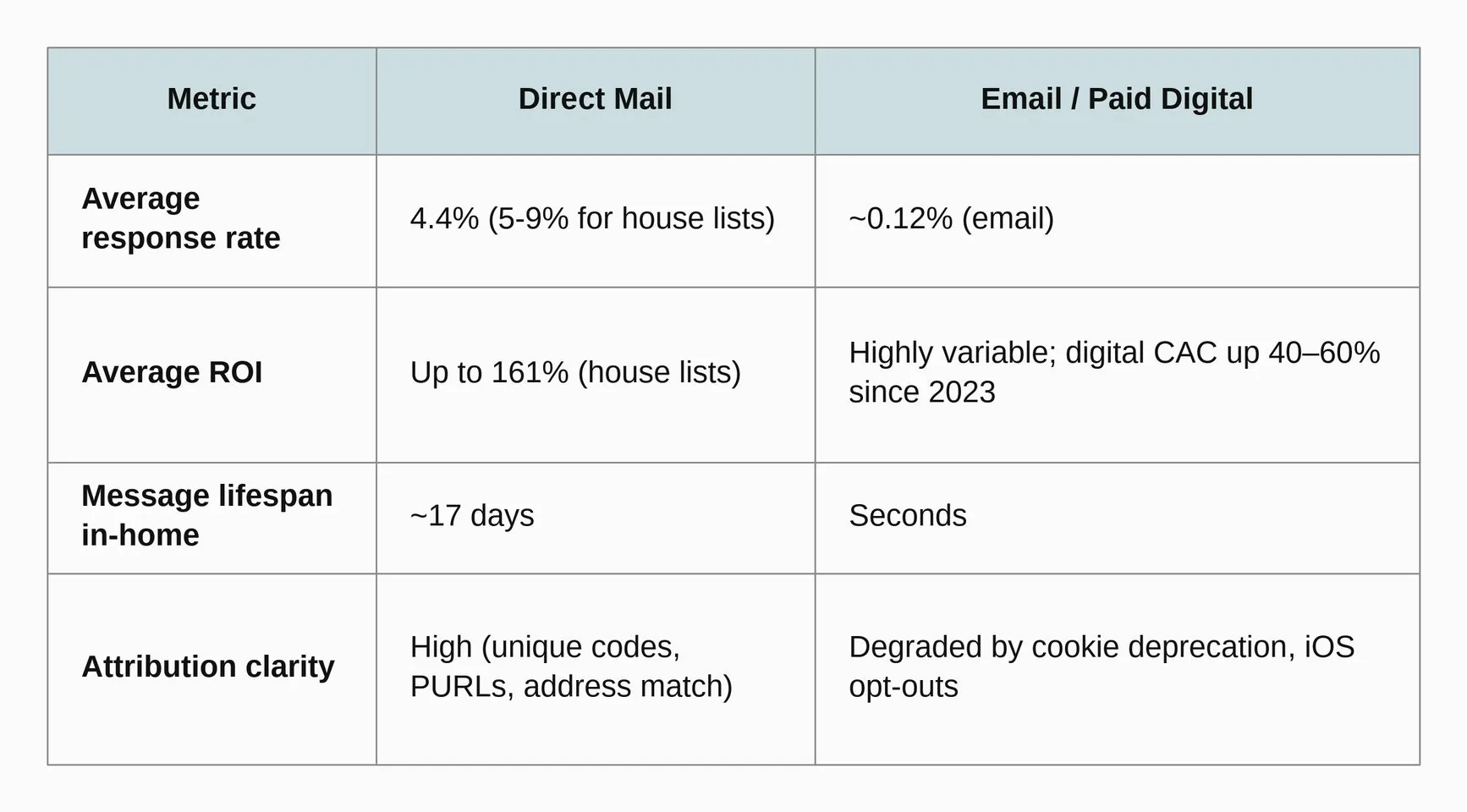
And the numbers back it up. Direct mail’s average response rate is 4.4%, versus roughly 0.12% for email. That’s a 35x gap. Mail to your own house list does even better, at 5-9%, with an average ROI of 161%, one of the best returns of any paid channel out there. Compare that to digital, where the cost to earn a dollar of new revenue keeps climbing across almost every industry. For a challenger brand trying to protect its margins while it grows, that contrast makes the case on its own.
Direct Mail vs. Digital: A Quick 2026 Snapshot
FAQs: Direct Marketing for Challenger Brands
Does direct mail work well with existing digital campaigns?
Yes, and often better than either one running by itself. When a mail piece shows up and then a retargeting ad or email echoes it a few days later, that repetition sticks. It doesn’t feel like two random, disconnected touches.
Is direct mail still worth it if my brand is digital-first?
More than worth it right now, honestly. Digital CAC keeps climbing and targeting keeps getting fuzzier, so a lot of D2C brands are finding their marginal dollar goes further in the mailbox than it does in another paid social campaign.
How does direct marketing compare to paid social for a growing brand?
Direct marketing goes to a name and address you actually know. Paid social is stuck relying on whatever the platform decides to show, and that matching has only gotten less precise. It shows up in the numbers, too. Mail response rates run about 35x higher than email, and pairing mail with digital retargeting pushes results even further.
What’s the fastest way to test direct marketing without a big commitment?
Grab a small house list, or a lookalike audience if your customer data is thin, and put a promo code or QR code on the piece so the results are actually trackable. Then weigh what comes back against your current digital CAC before you decide whether to scale it.
Ready to Kickstart Your Direct Mail Strategy?
You don’t need to overhaul your whole marketing plan to test this. Start with a house list, a clear offer, and a way to track response. Then see how the numbers stack up against what you’re paying for a click. If you want help pulling together a data-driven approach to direct mail, Speedeon’s team can walk you through it.